

The sweet science
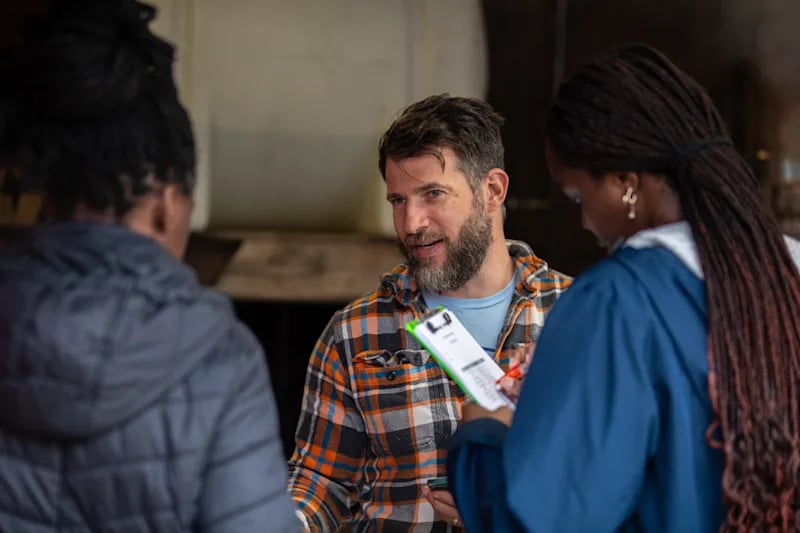
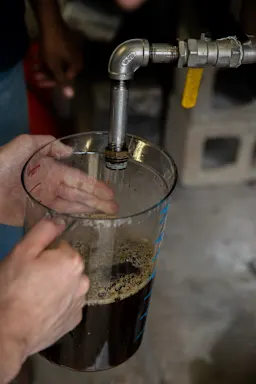
Each winter, intrepid Principia College students venture into the forests on campus, braving the cold in a quest for sap—maple sap, which, with some careful boiling and processing under the watchful eye of Professor John Lovseth (C'05), will become delicious maple syrup.
Sugar Bush Management—a class in the Center for Sustainability, Ecology, and Chemistry—has been a very popular general education course at Principia for more than two decades. The course began in 2001, after Professor Mike Rechlin recognized that the campus had enough mature sugar maples to support a small syrup operation.
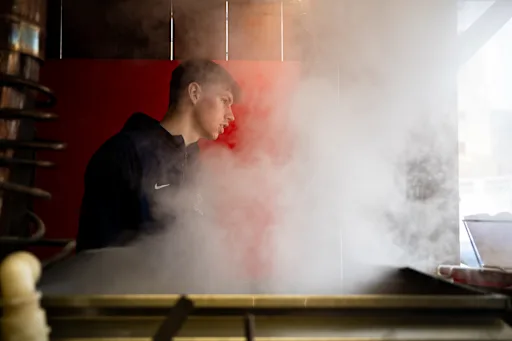
Lovseth took over teaching it in 2013—and his love for the subject is clear: his office is decorated with bottles of syrup produced by his students.
Each bottle represents hundreds of hours of labor and gallons and gallons of sap gathered by students. They range in color from a very light amber to a dark golden brown.
“I always get the first bottle [each class produces] and put it on my windowsill,” he says. Sometimes students design custom labels for the bottles, turning each season’s syrup into a small piece of campus history.
“This year, we did not burn any syrup, which is amazing,” says Lovseth, clearly proud of his students. “It was a very successful year.”
Learning that sticks
The class is essentially project-based, and the learning flows naturally, almost incidentally, with the process of making syrup. Lovseth uses a hub-and-spoke model to describe the curriculum: “The hub is making high-quality syrup,” he says. “Everything else—photosynthesis, forest management, the scientific method, tapping—is a spoke off that hub.”
Students also complete independent research projects. Each student chooses a question related to maple production, collects data, analyzes the results, and writes up their findings as a scientific study.
Lovseth estimates that on average about three-fourths of the students who take part in the class do not declare majors related to the sciences. The class serves as a great introduction to the sciences for both aspiring scientists and non-scientists alike.
By the end of the semester, they’ve not only produced syrup—they’ve conducted original research.
Managing the prairie with fire
While the Sugar Bush course focuses on forests, another major ecological effort on campus centers on prairie restoration.
Although known as the Prairie State, Illinois’ landscape has changed dramatically over time.
Historically, the state contained about 22 million acres of prairie. Today, less than 2,500 acres of native prairie remain.
Principia’s campus is unusual in that it still contains both remnant hill prairie—completely untouched by industry or agriculture—and restored prairie areas—land that was formerly degraded or used for agriculture, which is intentionally planted with native grasses and flowers.
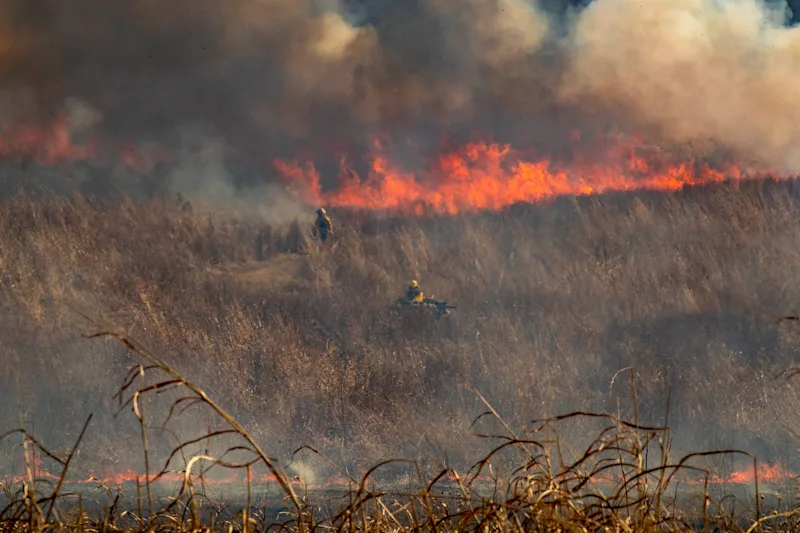
Maintaining those prairies requires an unexpected tool: fire.
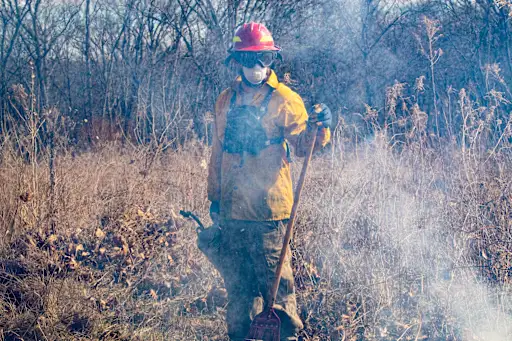
Controlled burns are essential to prairie ecosystems. Without periodic fire, grasslands naturally succeed to forests, where trees shade out the grasses and wildflowers that define prairie landscapes.
“Fire has shaped this ecosystem for thousands of years,” John explains. “When we burn, we’re not destroying the prairie—we’re actually perpetuating it.”
Many prairie plants are adapted to fire and thrive after burns. Grasses regrow quickly, while woody vegetation is suppressed. Over time, this cycle helps maintain the open, grass-dominated environment characteristic of prairie ecosystems.
To burn or not to burn
Despite their ecological importance, controlled burns are complex to organize.
The process requires coordination with the Principia Fire Brigade, permits from the Illinois Environmental Protection Agency, and careful monitoring of weather conditions.
The timing window is extremely narrow.
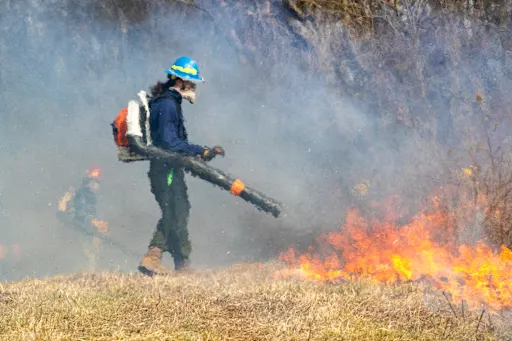
Conditions must be dry enough to burn but not too dry, warm enough for safe operations but not windy. In addition, faculty and students must be available to help conduct the burn.
Even with all those constraints, the college has successfully burned large sections of prairie nearly every year.
So far this season, about 102 acres of grassland have been burned, with plans to burn additional acreage if weather conditions allow.
Learning from the land
Although prairie burning isn’t yet tied to a single course the way Sugar Bush is, many classes rely on the landscapes it maintains.
Courses in forest ecology, wildlife studies, and grassland ecology all use these areas for field research and observation.
There are also plans to introduce a future course focused specifically on Fire Ecology and Management, which would connect prairie burns directly to classroom learning.
For students, the experience of seeing these ecological processes firsthand creates a deeper understanding than textbooks alone can provide.
And perhaps most importantly, it shows how human stewardship can work with natural systems rather than against them.
As John puts it, the most powerful lessons come when ecological concepts become tangible.
“It’s easy to understand when you can see it,” he says. “Whether it’s a bottle of maple syrup or a prairie coming back after a burn.”