Search
Organs and Carillon
Music has long been central to life at Principia College, supported by instruments built for both beauty and precision. The information below details the design and specifications of the campus pipe organs and carillon.

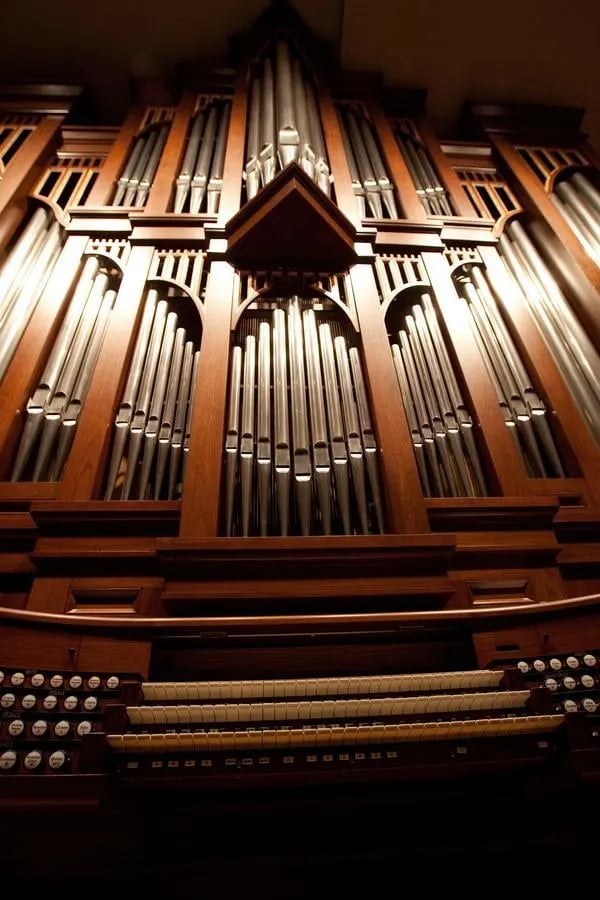
Casavant Frères Organ
Specification
- PRINCIPIA COLLEGE - COX AUDITORIUM
Elsah, Illinois - Casavant Frères
- 56 ranks, three manuals
- Opus 3838 — 2005
- 56 ranks • 3,125 pipes
History
After building Cox Auditorium in 1964, primarily for the annual Principia Public Affairs Conference and commencement ceremonies, Principia College leaders determined a pipe organ would enable Cox to accommodate a wider variety of activities.
Detlef Kleuker Orgelbau of Brackwede/ Westfallen, Germany, installed a two-manual, thirty-two rank organ with electric-slider action in 1967. Gifted by Mr. and Mrs. Russell V. Williams of Idaho Springs, Colorado, the instrument was a tribute to John Sammons, a Christian Science practitioner and teacher. The organ was mounted on a platform hung from the left side wall, near the stage, and the console was positioned in front of stage center. Famed American organist Virgil Fox performed the inaugural concert.
Over time, the instrument developed irreparable mechanical problems, and its neo-classical tonal design proved inadequate for the 1,100-seat auditorium. Although it was rebuilt and enlarged in 1985, the effort was unsuccessful, and the need for a reliable, highly versatile instrument in Cox Auditorium remained clear.
In 2001, three prominent North American organ builders studied the situation and submitted proposals for a mechanical-action organ that would reflect many of the tenets found in the organs of the great nineteenth-century French organ builder Aristide Cavaillé-Coll. Renowned organ builder Casavant Frères of St-Hyacinthe, Québec, was awarded the contract in 2002 after several individual donors and Principia’s 50th reunion classes of US ’48-’49, JC ’50-’51, and C ’52-’53 generously provided funding.
The organ, Casavant’s opus 3838, has three manuals, 56 ranks, and 3,125 pipes; the addition of one pedal rank is prepared for the future. The tonal architecture of the instrument is thoroughly grounded in the nineteenth-century French tradition. Dr. John R. Near, Principia College Organist and Professor of Music, drew up the stop list, and Casavant’s Tonal Director, Jacquelin Rochette, determined the pipe scalings and other tonal specifications.
The case design, conceived by Didier Grassin of Casavant, reflects the very successful Maybeck architecture that graces the original college buildings. Emulating the elegant Arts & Crafts feel, Casavant mixed strict main lines with gently curved pipe-shades. Great care was taken to strengthen the overall verticality of the composition by breaking up potential horizontal lines. The case is made of stained solid American walnut throughout, with highlights of natural maple in the pipe-shades. The polished tin façade provides a strong contrast with the soft grain of the walnut.
The position of the previous organ was inadequate for the large three-manual scheme envisioned for the new instrument. Locating the organ at the back of the stage would infringe too much upon the working floor space, and the low proscenium was considered a sound trap. Adding a side extension to the auditorium seemed a viable solution. It was felt that the organ should not project entirely sideways toward the audience, as the previous instrument had. Sketches were then prepared to study the feasibility of an angled case with a platform linking to the main stage.
However, steel columns inside the brick walls supported the building and could be neither suppressed nor moved. This added another layer of technical difficulties, as the organ would have to be built either beside or around the immovable pillars, and any solution encompassing a steel column would have to give good access to the windchests and pipework for maintenance and tuning. After many careful studies, Casavant proposed a solution where the organ would be angled by twenty degrees, with some of the key-action trackers brushing past a steel column. The success of the placement relied on the precision of the new building extension and Casavant’s own manufacturing, as both organ and building had to fit like hand and glove. It turned out that the construction of the new chamber was superbly crafted, and 30-foot-tall walls were impeccably vertical and placed within a quarter of an inch of the required dimensions.
The internal parts of the instrument are organized into two layers. The Grand Orgue (first manual), the Positif (second manual), and the small pipes of the Pédale occupy the front section in the protruding casework. The Récit Expressif (third manual) and the large pipes of the Pédale stand behind in the new chamber.
The organ is set on symmetrical windchests laid out in major thirds from tenor C for the manual divisions. Since the case follows a strict “Werk principle,” one can read the placement of the main divisions on the façade: the Positif, just above the console, is crowned by the Grand-Orgue and its Montre 8; the Pédale is on either side behind the 16’ Montre. The Récit Expressif is split into two sections: the flues, Basson-Hautbois and Voix humaine are at the front, and the 16’, 8’ and 4’ reed batteries are at the back.
The organ is articulated around a traditional 16’ Grand Orgue. The Récit Expressif is typical of the large Récit found in late grand Cavaillé-Coll organs, with the exception of the 16’ Bourdon doux that was placed in the Positif. The Positif is treated more classically with its series of mutations and a large-scale Cromorne. The Pédale is richly endowed from 32’ upwards, though the large reed and flue stops are obtained through extensions.
Thanks to the wealth of foundation stops, the organ is solidly grounded, and the generous basses contribute a wonderful gravity to the instrument. The mixtures have been purposely kept temperate, avoiding any aggressiveness, while the large number of reed stops—twenty percent of the ensemble—provides a thrilling tutti of great richness. The winding is done through large, single-rise reservoirs and wooden trunks. The key action has been realized with traditional wooden trackers, wooden squares, and steel rollers. The electric draw-stop action is complemented with a generous combination system.
Despite its curved draw-stop terraces and hand-lettered porcelain stop faces, the console is not trying to copy any Cavaillé-Coll examples. The various elements and their arrangement were chosen for their elegance and feel. It is a play of simplicity and richness with walnut highlighted by thin strips of ebony. The manual natural keys are covered with bone and the manual sharps are of ebony. All the electronic controls, with the exception of a small readout, are discreetly hidden behind small doors.
This magnificent Cox Auditorium organ brings an exciting dimension to the performance opportunities at Principia College and is a wonderful addition to the musical landscape of the greater St. Louis community.
This organ is dedicated to harmony.
“Harmony in man is as real and immortal as in music.”
Mary Baker Eddy, Science and Health, p. 276.
Stoplist
| GRAND ORGUE (MANUAL 1) | POSITIF (MANUAL II) | RÉCIT EXPRESSIF (MANUAL III) | PÉDALE |
|---|---|---|---|
Montre 16' |
Bourdon doux 16' |
Diapason 8' |
Soubasse 32' |
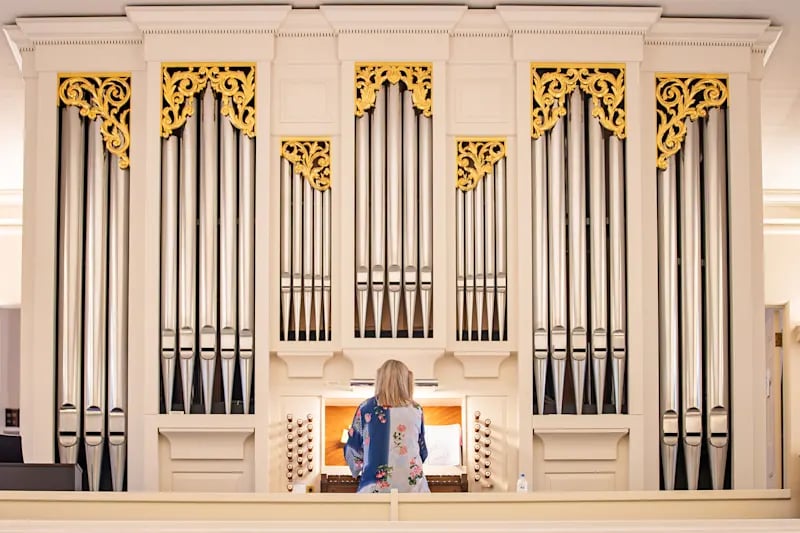
Martin Ott Organ
Specification
- PRINCIPIA COLLEGE CHAPEL
- Elsah, Illinois
-
Martin Ott Organ Co.
Opus 66 — 1992 - 28 stops • 34 ranks
Stoplist
| GREAT | SWELL | PEDAL |
|---|---|---|
Bourdon 16' |
Stopped Flute 8'
|
Subbass 16'
|
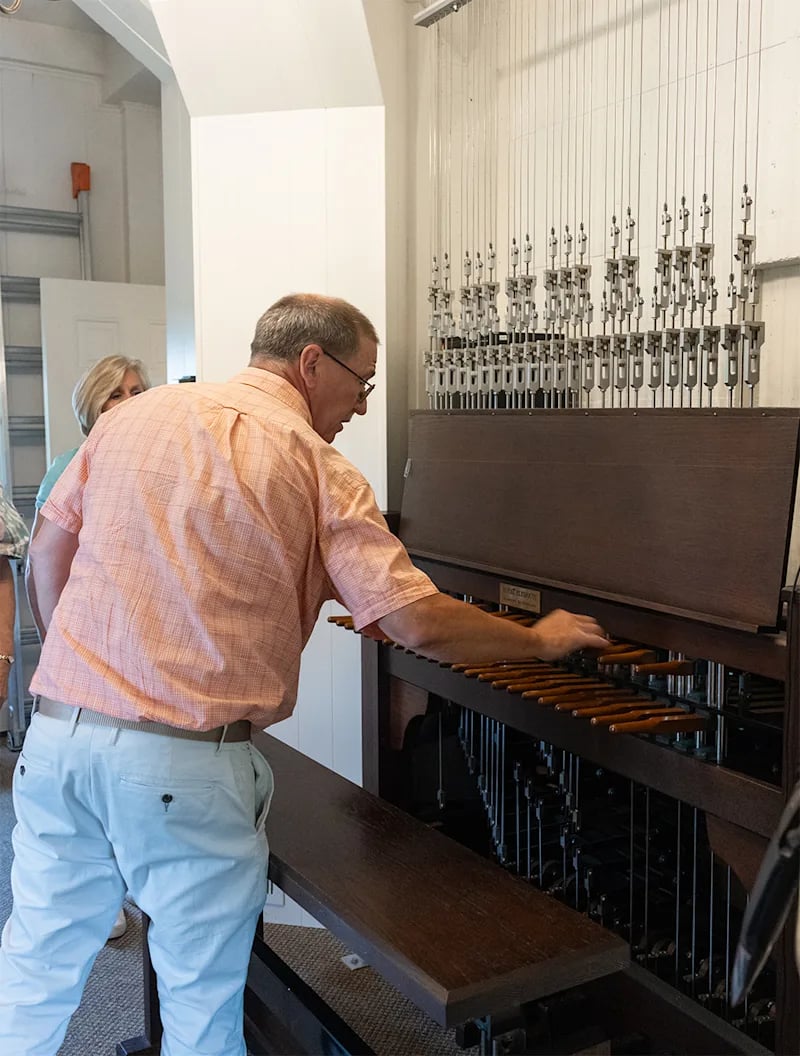
Jean L. Rainwater Carillon
About the Carillon
The Jean L. Rainwater Carillon at Principia College is a 39-bell musical instrument located in the College Chapel tower in Elsah, Illinois, and is part of a 600-instrument network documented around the world. Played from a keyboard below the belltower, the carillon’s music carries across campus. Donated in honor of Jean L. Rainwater, the carillon serves as a centering communal presence for concerts, chapels, campus events, and daily life at Principia, making space for the sacred and creative.
Music at Principia
These instruments are just one part of the rich musical tradition at Principia College. Discover how students study, perform, and grow within the College’s music program in the Center for the Arts.